

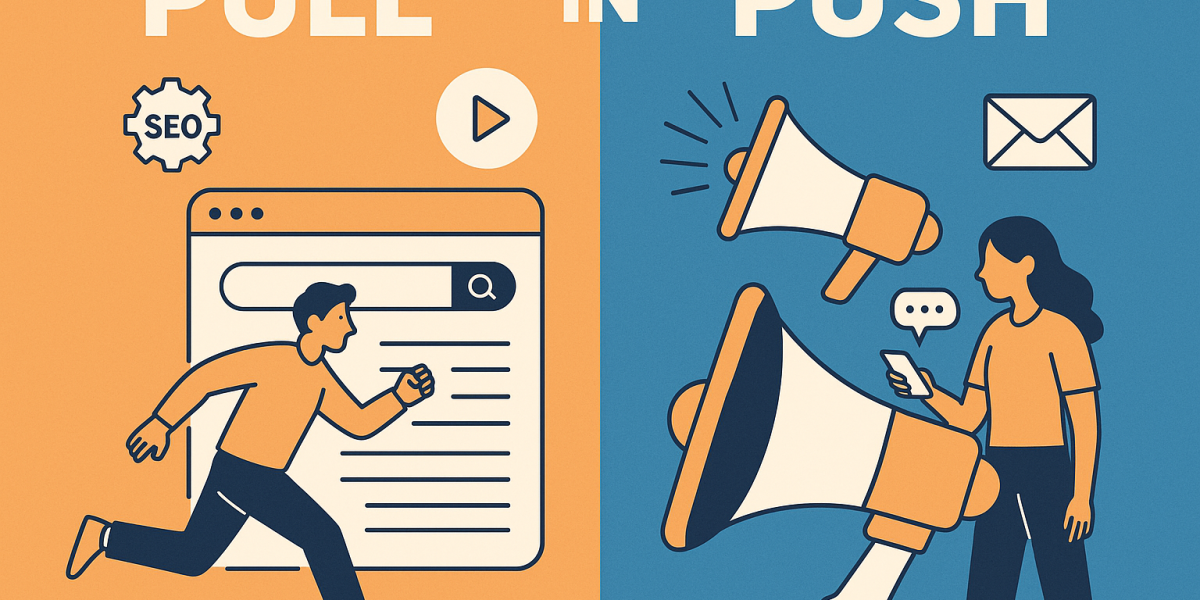
Modern digital marketing offers numerous strategies for companies to reach their target audiences. Among the most fundamental approaches are pull (attraction) and push (pushing) advertising, which differ in their basic philosophy of engaging users. They are not just two separate approaches but two sides of the same coin, addressing different stages of the buyer's journey. Understanding their dynamics is crucial for planning successful campaigns, optimizing advertising budgets, and achieving maximum return on investment (ROI).
In the following, we will deeply analyze both strategies, place them in the context of the sales funnel, and through detailed practical examples, show how their synergy creates a winning formula for digital growth.
What is pull advertising and when to use it?
Pull advertising is based on users actively seeking information about products or services themselves. The goal of the pull strategy is for the brand to come to the forefront at the moment when a potential customer expresses interest. It primarily operates in the middle and lower stages of the sales funnel (consideration and decision phase), when the user is already aware of their problem and actively seeks the best solution.
The most common pull advertising channels include:
Search Engine Optimization (SEO): Creating quality content (blogs, guides, case studies) that organically ranks high on search engines like Google for keywords with high purchase intent (e.g., "best accounting service").
Content marketing: Writing in-depth articles, e-books, and organizing webinars that educate the user, help them make decisions, and build trust in the brand as an expert in its field.
Paid search ads (Google Ads advertising): Purchasing ad space at the top of search results for precisely defined search queries. This allows for immediate visibility at the moment when the customer expresses a need.
When to use pull advertising:
When you want to capture users who are already in the phase of actively researching and comparing offers.
For products or services where the decision-making process is longer and based on gathering information (e.g., buying a car, enrolling in a university, choosing B2B software).
When you want to build long-term authority and reduce dependence on paid advertising.
Practical example:
The company "Sončni Dom d.o.o.", which deals with the sale and installation of solar power plants, implements a comprehensive pull strategy:
SEO and content marketing: They prepare an extensive blog post titled: "The cost of a solar power plant for a family house in 2025: What affects the final amount?". This attracts organic traffic from users who are in the research phase.
Google Ads: At the same time, they purchase ads for keywords such as "turnkey solar power plant" and "Eco Fund subsidies for solar power plants", capturing users who are closest to the purchase decision.
Push advertising for creating new demand
Push advertising is a proactive approach where the brand "pushes" its message in front of an audience that may not yet be thinking about a purchase or is not even aware of the product's existence. The goal is to create awareness, spark interest, and generate demand. This strategy is crucial for the top stage of the sales funnel (awareness phase).
The main push advertising channels are:
Display ads (display network): Image and video ads (banners) on websites, portals, and in apps, targeted based on demographic data, interests, and users' online behavior.
Social media advertising: Visually appealing ads on platforms like Facebook, Instagram, LinkedIn, and TikTok, allowing for extremely precise targeting of specific audience segments. In terms of sales in the B2C segment, Facebook advertising leads.
Video advertising: Ads before, during, or after video content on platforms like YouTube, which are excellent for storytelling and building an emotional connection.
Email marketing: Sending promotional messages and newsletters to an existing customer base and followers to encourage repeat purchases or introduce novelties.
When to use push advertising?
When launching an innovative product or service that the market is not yet aware of and therefore no one is searching for it.
For quickly building brand awareness.
For promoting products based on impulsive purchases (e.g., fashion, cosmetics, event tickets).
Practical example:
A fashion brand launching a new collection of women's swimsuits will reach users interested in fashion through targeted advertising on Instagram, even if they are not actively looking for new swimsuits at the moment.
Practical example:
Slovenian startup "EkoSok", launching a new line of cold-pressed juices with added adaptogens (an ingredient less known to the general public).
Instagram & Facebook Video Ads: They create short, dynamic video ads showing energetic people in nature. They target users interested in "healthy eating", "yoga", "fitness", and "well-being". The message focuses on the benefits of adaptogens (e.g., "Reduce stress and increase energy naturally").
Influencer Marketing: They connect with micro-influencers in the wellness field, who present the product to their followers, thus credibly "pushing" the novelty to the market.
Synergy of push and pull advertising
The most successful digital strategies are never just "push" or "pull", but a carefully planned combination of both. Push creates the initial spark, while pull turns it into a fire.
Let's look at the entire buyer's journey using the example of the startup company "EkoSok":
Phase 1: PUSH (Awareness): Potential customer Ana sees an attractive video ad for "EkoSok" on Instagram. She had never heard of juices with adaptogens before, but the ad sparks her interest. She doesn't buy immediately but remembers the brand name.
Phase 2: PULL (Consideration): A few days later, Ana types into Google: "what are adaptogens in a drink". At the top of the results, she finds an SEO-optimized article on the "EkoSok" blog titled "Everything you need to know about adaptogens". She reads the article and gains trust in the company's expertise.
Phase 3: PULL (Decision): When she decides to try the product, she types "buy EkoSok adaptogens" into Google. She clicks on a paid Google ad that takes her directly to the product page, and she makes a purchase.
Phase 4: PUSH (Loyalty): A week after the purchase, Ana receives an email (push) with a 15% discount code for her next order.
This example clearly shows how the push strategy fills the top of the sales funnel, while the pull strategy converts these warmed-up contacts into customers.
Understanding the difference between pull and push advertising on the internet is crucial for the success of digital campaigns. Push is like a megaphone, telling the world you exist. Pull is a magnet, attracting those who need you. The best results are usually achieved with a combination of both approaches, where push ads create interest, and pull allows conversion into an actual purchase.
Companies that master the art of intertwining both approaches can effectively guide customers through the entire buying journey, build lasting recognition, and maximize the return on their advertising investments in a dynamic digital environment.

My name is Anže and I am a Magento certified solution specialist and builder of many award-winning online stores. I am the architect of all Degriz projects.
Write to me →